Translate

Sunday, May 4, 2014

Marhaba Ya Uhti


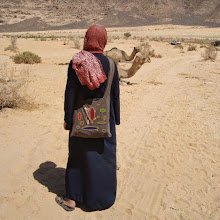
I wore niqab for the first time during the four hour ride by shared taxi from Amman to Aqaba.  I arrived to Amman’s south bus station shortly after dark.  Clad in a cream colored scarf and niqab, I presented as an educated, yet devout woman – possibly travelling for work or family reasons. 

Marhaba ya uhti,” the driver spoke softly to me – using a polite tone and a greeting appropriate to an uht (sister) – applied to a woman in recognition of her devotion to Islamic practice. 

“Would you like to sit in front?” he continued.  I nodded quietly – accepting the offer of a seat which would ostensibly allow me to relax at a distance from the other (male) passengers.

This was the first shared taxi ride from Amman to the south in which I was asked no personal questions, offered no cigarettes and treated with complete deference by all present.

Monday, April 21, 2014

Material Modesty: Framing the Niqab


One of my favorite things about living in southern Jordan is the sense of community.  I came across a set of statistics once that placed the population of Aqaba Governorate at around 103,000 people in 2005 – though the population has grown in 9 years, I can’t imagine that it has grown much.  As a result of this small population and the family-based nature of the society – people know each other and they know each other’s families.  It’s hard to come across a stranger in southern Jordan – if you don’t know the person in front of you – you can be sure that you have someone in common.  As a result, I find that I often encounter people that I know and like.  On the flip side, is the sense sometimes that everyone knows, for better or for worse, one’s business.  While this creates a strong sense of accountability in one’s behavior – for me, as the only single, foreign woman in the Wadi Rum area, I sometimes feel like a particularly intriguing microscope specimen.  There are days when I wish that I was invisible and there are also days when I wish that I didn’t have to explain myself to every taxi driver, shopkeeper and restaurant tout – particularly during my weekly visits to Aqaba.

Fortunately, traditional Arab society provides a solution, for women, to the problem of anonymity through an item of clothing known by a variety of names internationally, but locally, as the niqab or heimar.  For those interested in a technical difference, the niqab is the piece of fabric that covers just the face while the heimar is a combined head and face covering that leaves the eyes visible.  Neither of these should be confused with the burqa which covers the entire body.

The tradition of women covering their faces is a pre-Islamic one which dates back at least to the Roman Empire, where women of wealth and influence covered their heads and, in some cases, faces to differentiate themselves from the commoners.  Upper class women in the Ottoman Empire covered their faces as well but the tradition of face-covering did not arrive to the Arabian Peninsula until the 1700s. From a religious perspective, the main mention of modesty requirements vis a vis dress in the Koran is as follows in Sura An-Nur (24:30-31):

24:30
24:30

24:31
24:31


Different translations are available 24:30 and 24:31.

You'll note that while both men and women are asked to be modest - there is no clearly prescribed Islamic dress.   :)  As with most divinely revealed scripture, the Koran leaves a great deal to interpretation.  In fact, one of the most beautiful things (and one of the great challenges) about Islam is the freedom that it gives to its scholars and practitioners to interpret the religion to their time and place.  As a result, a cultural practice of face-covering which is equated with a high degree of modesty has been deemed by some scholars as a practice that is most suitable for women wishing to express their religious devotion through material means.  It is these interpretations which dominate the practice of Islam in the towns and villages of Jordan's southern desert - the communities in which I choose to live.

That said, my initial decision to wear niqab was motivated not by religion but by a desire for anonymity in the pursuit of daily tasks outside the house - hence mostly expedience.  Modesty was a part of my motivation in the sense of modesty as an effort to not draw attention to oneself and one's actions.  I've worn niqab now in most public spaces for the past two months.  The addition of a small piece of strategically placed fabric to my dress has been opened doors of inquiry, controversy and learning that I never would have imagined.  I've learned more about myself and my faith and gained an even greater understanding of the values of the community in which I live.  I'm happy to share the story with you.

Tuesday, March 11, 2014

Second Coming ;)

About five days after returning to Jordan, I was thrilled to welcome the Steyer family to Wadi Rum.  Long-time followers of this blog may remember Law in the Desert, one of my first posts.  The Steyers were among my first clients in Jordan and I have grown quite fond of them, as we've stayed in touch over the years.  Together we spent a day in Wadi Rum and a day in Petra - as it was mom Margaret's sojourn to Jordan.  We dined at Al Qantarah Restaurant, my favorite Wadi Musa restaurant.  They do a great set menu of local Jordanian cuisine.  Here we are, having enjoyed a tasty evening meal!


Saturday, March 8, 2014

New York - Istanbul - Aqaba


Returning to Jordan after four months in the US – the longest period of time that I’ve been away since arriving here in 2006 – was not as I anticipated.  After the significant shock of readjusting to life in the US, a country that I haven’t called home for 12 years, I imagined that my return to southern Jordan would be as a stranger and that I would struggle to adjust to changes that have taken place - both personally and professionally in my life - since leaving Jordan last October.

I arrived in Aqaba from Istanbul at 3 am on 17 February and hopped into a taxi to the center of town.  My cab driver was a friendly man from the hill town of Tafileh who welcomed me profusely back to Jordan, complimented my Arabic and then promptly tried to overcharge me.  Some things never change. :)

As I stepped out of the taxi and Mohammed, the Egyptian receptionist at the much loved funduk al Quds (Jerusalem Hotel), smiled gently as he helped me to gather my bags, a sudden sense of well-being washed over me.  I realized that as far as I may be from my family and country of birth, I have, indeed, returned home.  
Aqaba and the Red Sea
Photo courtesy Al Amer Chalets

Tuesday, December 17, 2013

The Practice of a Renunciate is Not the Practice of a Householder


For the past two weeks, I've been participating in a yoga teacher training course at Kripalu, a retreat center in Western Massachusetts.  The yogic tradition fascinates me because it is being embraced in its modern form by so many people from my background - European - American - educated - middle - upper middle class - and also because of the fear that yoga invokes in some interpretations of Islam that I’ve come across in Jordan.  The month long course, split into two two week sessions, allows me to gain a fuller understanding of how yoga is taught, to developing greater physical awareness and also to gain skills that will allow me to offer a holistic approach in personal growth and development to my students.

Now - what have I found?

The first week of the course, one of my teachers said to me: "The practice of a renunciate is not the practice of a householder."  

When I first heard this statement, my mind jumped immediately to a comparison of the physical practices of Islam and yoga.  As a yogi at Kripalu, I am expected to engage in nearly four hours of physical practice per day.  As a Muslim anywhere in the world, the physical requirement of worship is five daily prayers which at a minimum add up to 30 minutes of physical movement.  In my mind, yoga at Kripalu offers a physical practice for a renunciate while Islam, with no monastic tradition, calls for a world of householders and offers a subtle yet powerful physical practice.  I should also clarify that while Muslim prayer is a clearly defined devotional act, physical yoga practice at Kripalu is an exercise designed to promote health and wellness.  Islam externalizes that which we worship, Kripalu yoga internalizes it.  Note also that while Islam is submission to the will of God, yoga in the original Vedic Sanskrit expresses union, connection, addition and joining together.

The morning after receiving the above statement, I emerged from a deep, hour and forty five minute physical practice with my head in the clouds, feeling a desire to stay there - avoiding the people around me and their apparent quirks - I've discovered that when my mind is quiet, I can often pick up on the louder thoughts and feelings of those around me - for better or for worse :)  The hour plus period between the end of morning yoga and the first class is held in silence and on my way to breakfast, I found myself dodging gazes, interactions and greetings.  I appreciated my alone-ness though simultaneously feeling awkward and a bit guilty for withholding my greetings to other souls.  

How do we greet others from a place of silence?  I reflected. Can we truly live a full life if we avoid interactions with other people?

Though a bit of peace felt good as I ate breakfast (during which I chose not to have eggs because they seemed too loud!), I found myself slowly waking up to the physical world around me - the place where humans live and learn, exist and embrace our lives.

After this experience, I felt that the physical yoga practice I had engaged in created an over emphasis on the individual and a forgetfulness of the human community - which makes some sense - if one spends four hours a day in an intense individual practice.  As I have learned more about yoga, particularly some of the elements that dictate how a yogi interacts with other humans, I recognize that though modern yoga does place emphasis on the individual, the community is not forgotten.  It is simply the case that yoga as an individually oriented practice dictates the expectations of a renunciate as he or she develops him or herself within a spiritually conscious community.  Although most practitioners of yoga in the US today are not renunciates, I’ve come to believe that the individual oriented nature of the practice is more resonant in a society that emphasizes the individual and his or her experience.

Islam, as I have experienced it in Jordan, in contrast, meets the needs of a householder within a greater community of spiritually dedicated Muslims.  The five prayers bookend the day.  We rise and breakfast at dawn (fair) and spend the morning engaged in work, dhuhr is prayed at mid-day, followed by lunch and rest-time through early afternoon, when asr is prayed.  After the asr prayer, errands and visits are performed through sunset and the maghrib prayer and dinner is followed by a reasonably early bedtime after people pray ishaa.  Prophet Mohammed's statement that the best thing in a righteous life is a righteous spouse recognizes the unity that can exist between two humans dedicated to building a life together and the idea that Islam is a surrender not only to God but also to one's place in the human community.

Ultimately, one chooses a path that is most relevant to one's life and as the tide of the human experience changes, we move on from practices that do not adapt to meet the needs of our environment.  I believe that yoga is gaining footing in North America and Europe because it offers a deeply physical element to a largely desk-bound population, while also offering a secular framework to those who have distanced themselves from conventional religion.  The deep family oriented nature of dominant interpretations of Islam today thrives in regions where family bonds reinforce the religious teachings of the Prophet and vice versa.  Simultaneously, as environmental factors such as material wealth and government regulation increase in Muslim societies, family bonds and people's approach along with them evolve and change.

Faith and its practice are as dynamic in the world in which we experience them.

Elements of Muslim Prayer


Friday, November 29, 2013

Off to Kripalu!

One of the topics that has most intrigued me over the past few years is the concept of multi and inter-faith communications and understanding.  Living in a traditional Arab Muslim society, I often struggle to understand what are the true practices of Islam and what are the practices that ultimately stem from culture, adopted into the religion in order to reinforce the identity of the community.

Earlier this fall, a dear friend and Islamic scholar said to me:

"Alena, the only red line of Islam is belief in and submission to one God."

A beautiful statement but one fraught with challenges, as it indicates the possibility that anything goes.

In the hands of an empowered, self-confident, self-aware individual, I imagine a world of non-judgement, compassion, forgiveness and peace.  In the hands of disempowered, insecure, unaware individuals - all hell is likely to break loose.

Isn't this the case with all things in this world?  Ultimately, our world is driven by humanity and the tone of humanity sets the tone for our world and how we experience it.

To make a long story short, yoga has come under discussion in some Muslim communities - should devout Muslims practice yoga or is it a competing spiritual system which must be avoided so as not to taint or distract from a pure Islamic practice?

In culinary terms, can we combine chana masala and felafel and enjoy a fulfilling meal that sustains our being?  I say yes - after all both dishes are just chick peas in different forms - plus I always find myself dipping my felafel (chickpeas) into my hummus (also chickpeas)!  Ok... maybe I need a different metaphor... inshallah, you get the jist.

I digress ... I'm off to Kripalu to participate in a yoga teacher training on Sunday to confirm my belief that though our paths may be different - in the end we are all heading for the same destination.

Stay tuned!


Photo by Jolinda Cath

Thursday, November 28, 2013

A New Look ... A New Name ... A New Adventure

In 2009, as I ventured off into the world of educational tourism, my godmother suggested that I start a blog as a means of advertising.  I posted fairly consistently to South Jordan Sojourn for two years before life took over.  Now after some thought and re-evaluation, I have decided to re-name the blog as a means of more accurately portaying the work that I find myself doing in the world.  For many years, I've supported the external exploration of the world and its beauty. More and more, however, I find myself supporting the internal exploration of those around and have found that the concept of pilgrimage fits nicely with what I find myself doing.  A pilgrimage is a journey of faith through an external world that allows for better understanding of one's inner self and things that are greater than that self.  Off we go!  :)

Erjud al Matalga, southern Jordan