Translate

Wednesday, May 7, 2014

Action/Reaction


Note: names have been changed to protect privacy.  :)

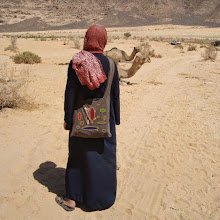
In the community where I’ve lived for the past year and a half, most women cover their faces in public.   The attitude toward the face-covering stems from a mixture of religion and culture.  Some women cover their faces out of devotion but others do it simply to protect their identity when travelling in the public world of men – outside of home and tribe.  3shan akhud ra7tee.  This phrase, which I've heard from many covered women translates roughly to 'take a rest, be comfortable, not be stressed out.'  When one is used to living in a domestic feminine world at home in the village -  full of sisters, aunts and cousins - food, babies and softness - diving into the rough world of men is jarring.  Though niqab/heimar is a dress code that is not traditional to the Bedouin community - as Islamic interpretations have spread and changed and as the post-settlement Bedouin populations have been exposed to different influences - the niqab has gained popularity for a variety of reasons.  While it can be nearly impossible to separate culture and religion, I find that some women cover for God, while others do it for comfort, for family, upon request of their husbands or simply because their older sisters do it (and in two cases, against the wishes of male relatives).  However, in some cases, women who might cover their faces when travelling do not cover their faces in the safety of the family neighborhood.  

When I first started wearing the niqab, which I did with little understanding or guidance (what can I say?  I'm famous for spontaneous decision-making!), I picked and chose the places where I wore it.  In self-defined private spaces – like my neighborhood, place of work and in the homes of friends, I showed my face.  In public spaces, I covered it.  Here is what I found.

Walking through Aqaba with a covered face offers a dramatic change from what I have previously experienced.  In the souq, where the Egyptian store-minders are excited to sell and promote\ their goods with a shout of hello! or welcome! – all I hear is a gentle ‘please, ma’am, buy from us.’  No one else looks my way.  When walking with a female friend who covers her head and wears either the long-robed abaya or jilbab, she notes a difference in her treatment as well – no one speaks to her when she is with me.

Every space that I return to with a covered face, I wonder what the reaction will be.  I’m familiar with the different opinions on niqab, but experience brings a new level of understanding.

After a month in-country, it’s time to renew my visa.  I head to the police station.  Although a government entity and therefore staffed by both genders, individual police officers, as in most places, tend to a more traditional mindset.  I am met with incredible enthusiasm by the two male officers handling my renewal. 

“Are you Muslim?”
“Yes.”
“Since how long?”
“About five years.”
“And how long have you worn this?”
“Just a month – but not everywhere.”  (As we shall see, this honest statement will later cause some challenges.)
“That’s fine.  As a Muslim, you are only required to cover your head.”

I nod politely.  The conversation shifts as one of the officers inspects my passport.

“It’s so great you are Muslim!  Hey!  You’re born in 19--! I’M born in 19--!  You’re birthday is 2- October?!  Mine is the 1-th!  I’m just ten days older than you!” 

He’s as a giddy as a school boy.  I cease conversation and sit quietly until my renewal is complete.

I begin to notice that a different dress code attracts a different type but does not necessarily stymie one’s attractiveness.

It’s been a while since I visited my old neighborhood.  My former neighbors are truly gentle people – their love of food, farming and a quiet life is one that I’ve always appreciated.  They don’t stray far from home and when I think of them, I am reminded of Tolkein’s hobbits.  My desert hobbits are among the most Muslim of people I’ve known, taking their practice seriously – keeping their prayers, acting with generosity and compassion, open to learning and sharing with those who are different and nearly always reserving judgment.  The neighborhood is full of olive trees, grape arbors and fruit trees.  A deep sense of peace emanates from their land.  The most devout ladies in this neighborhood wear niqab and their intention is a religious one. 

Selma and I are sitting on the veranda, sharing tea and conversation.  My niqab is flipped up over my head - my face revealed.  Her teenage niece, visiting from the city, drops by.

“Lina!  (That's me.) Mabrouk il niqab!” (Congratulations on your niqab!)

I blush and stammer a polite thank you.

I start to understand that for faithful Muslims the choice to wear niqab is one not to be taken lightly and that when worn by a practicing Muslim – eg. not for reasons of comfort, family or protection - comes an expectation of behavior and practice.  

My 'hood.

Sunday, May 4, 2014

Marhaba Ya Uhti


I wore niqab for the first time during the four hour ride by shared taxi from Amman to Aqaba.  I arrived to Amman’s south bus station shortly after dark.  Clad in a cream colored scarf and niqab, I presented as an educated, yet devout woman – possibly travelling for work or family reasons. 

Marhaba ya uhti,” the driver spoke softly to me – using a polite tone and a greeting appropriate to an uht (sister) – applied to a woman in recognition of her devotion to Islamic practice. 

“Would you like to sit in front?” he continued.  I nodded quietly – accepting the offer of a seat which would ostensibly allow me to relax at a distance from the other (male) passengers.

This was the first shared taxi ride from Amman to the south in which I was asked no personal questions, offered no cigarettes and treated with complete deference by all present.

Monday, April 21, 2014

Material Modesty: Framing the Niqab


One of my favorite things about living in southern Jordan is the sense of community.  I came across a set of statistics once that placed the population of Aqaba Governorate at around 103,000 people in 2005 – though the population has grown in 9 years, I can’t imagine that it has grown much.  As a result of this small population and the family-based nature of the society – people know each other and they know each other’s families.  It’s hard to come across a stranger in southern Jordan – if you don’t know the person in front of you – you can be sure that you have someone in common.  As a result, I find that I often encounter people that I know and like.  On the flip side, is the sense sometimes that everyone knows, for better or for worse, one’s business.  While this creates a strong sense of accountability in one’s behavior – for me, as the only single, foreign woman in the Wadi Rum area, I sometimes feel like a particularly intriguing microscope specimen.  There are days when I wish that I was invisible and there are also days when I wish that I didn’t have to explain myself to every taxi driver, shopkeeper and restaurant tout – particularly during my weekly visits to Aqaba.

Fortunately, traditional Arab society provides a solution, for women, to the problem of anonymity through an item of clothing known by a variety of names internationally, but locally, as the niqab or heimar.  For those interested in a technical difference, the niqab is the piece of fabric that covers just the face while the heimar is a combined head and face covering that leaves the eyes visible.  Neither of these should be confused with the burqa which covers the entire body.

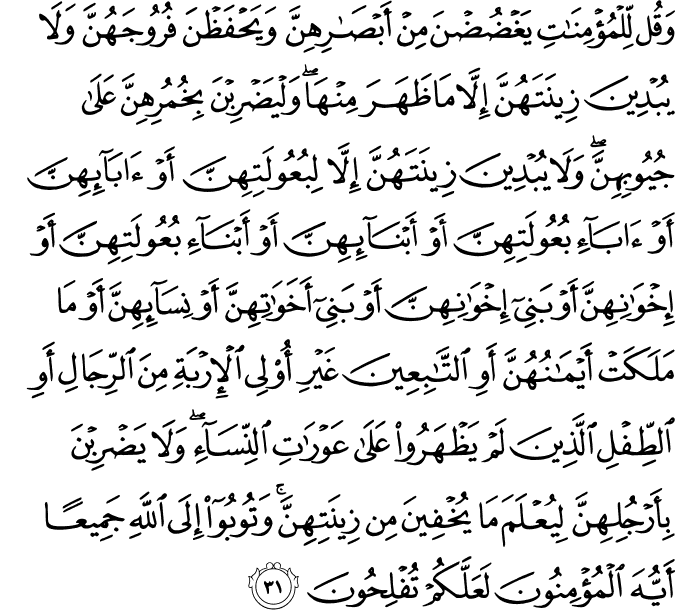
The tradition of women covering their faces is a pre-Islamic one which dates back at least to the Roman Empire, where women of wealth and influence covered their heads and, in some cases, faces to differentiate themselves from the commoners.  Upper class women in the Ottoman Empire covered their faces as well but the tradition of face-covering did not arrive to the Arabian Peninsula until the 1700s. From a religious perspective, the main mention of modesty requirements vis a vis dress in the Koran is as follows in Sura An-Nur (24:30-31):

24:30
24:30

24:31
24:31


Different translations are available 24:30 and 24:31.

You'll note that while both men and women are asked to be modest - there is no clearly prescribed Islamic dress.   :)  As with most divinely revealed scripture, the Koran leaves a great deal to interpretation.  In fact, one of the most beautiful things (and one of the great challenges) about Islam is the freedom that it gives to its scholars and practitioners to interpret the religion to their time and place.  As a result, a cultural practice of face-covering which is equated with a high degree of modesty has been deemed by some scholars as a practice that is most suitable for women wishing to express their religious devotion through material means.  It is these interpretations which dominate the practice of Islam in the towns and villages of Jordan's southern desert - the communities in which I choose to live.

That said, my initial decision to wear niqab was motivated not by religion but by a desire for anonymity in the pursuit of daily tasks outside the house - hence mostly expedience.  Modesty was a part of my motivation in the sense of modesty as an effort to not draw attention to oneself and one's actions.  I've worn niqab now in most public spaces for the past two months.  The addition of a small piece of strategically placed fabric to my dress has been opened doors of inquiry, controversy and learning that I never would have imagined.  I've learned more about myself and my faith and gained an even greater understanding of the values of the community in which I live.  I'm happy to share the story with you.

Tuesday, March 11, 2014

Second Coming ;)

About five days after returning to Jordan, I was thrilled to welcome the Steyer family to Wadi Rum.  Long-time followers of this blog may remember Law in the Desert, one of my first posts.  The Steyers were among my first clients in Jordan and I have grown quite fond of them, as we've stayed in touch over the years.  Together we spent a day in Wadi Rum and a day in Petra - as it was mom Margaret's sojourn to Jordan.  We dined at Al Qantarah Restaurant, my favorite Wadi Musa restaurant.  They do a great set menu of local Jordanian cuisine.  Here we are, having enjoyed a tasty evening meal!


Saturday, March 8, 2014

New York - Istanbul - Aqaba


Returning to Jordan after four months in the US – the longest period of time that I’ve been away since arriving here in 2006 – was not as I anticipated.  After the significant shock of readjusting to life in the US, a country that I haven’t called home for 12 years, I imagined that my return to southern Jordan would be as a stranger and that I would struggle to adjust to changes that have taken place - both personally and professionally in my life - since leaving Jordan last October.

I arrived in Aqaba from Istanbul at 3 am on 17 February and hopped into a taxi to the center of town.  My cab driver was a friendly man from the hill town of Tafileh who welcomed me profusely back to Jordan, complimented my Arabic and then promptly tried to overcharge me.  Some things never change. :)

As I stepped out of the taxi and Mohammed, the Egyptian receptionist at the much loved funduk al Quds (Jerusalem Hotel), smiled gently as he helped me to gather my bags, a sudden sense of well-being washed over me.  I realized that as far as I may be from my family and country of birth, I have, indeed, returned home.  
Aqaba and the Red Sea
Photo courtesy Al Amer Chalets